Jun / Summer surplusEnergy available now. A reason to store it for later.
Illustrative normalized profiles. Not measured household data or a performance forecast.
A thick iron plate does not react uniformly through its mass. Performance depends on surface area, grain structure, porosity, oxide formation, hydrogen evolution and electrolyte access.
- Handling
- Current collection
- Fluid distribution
- Drainage
- Preservation
- Electrochemical activity
- Iron utilization
- Hydrogen suppression
- Cycle life
The shape moves the liquid.
The surface stores the energy.
Published iron-air research shows flat iron sheets have limited practical reversible capacity; high-performance electrodes rely on increased active surface area and engineered microstructure. See the research agenda ↗
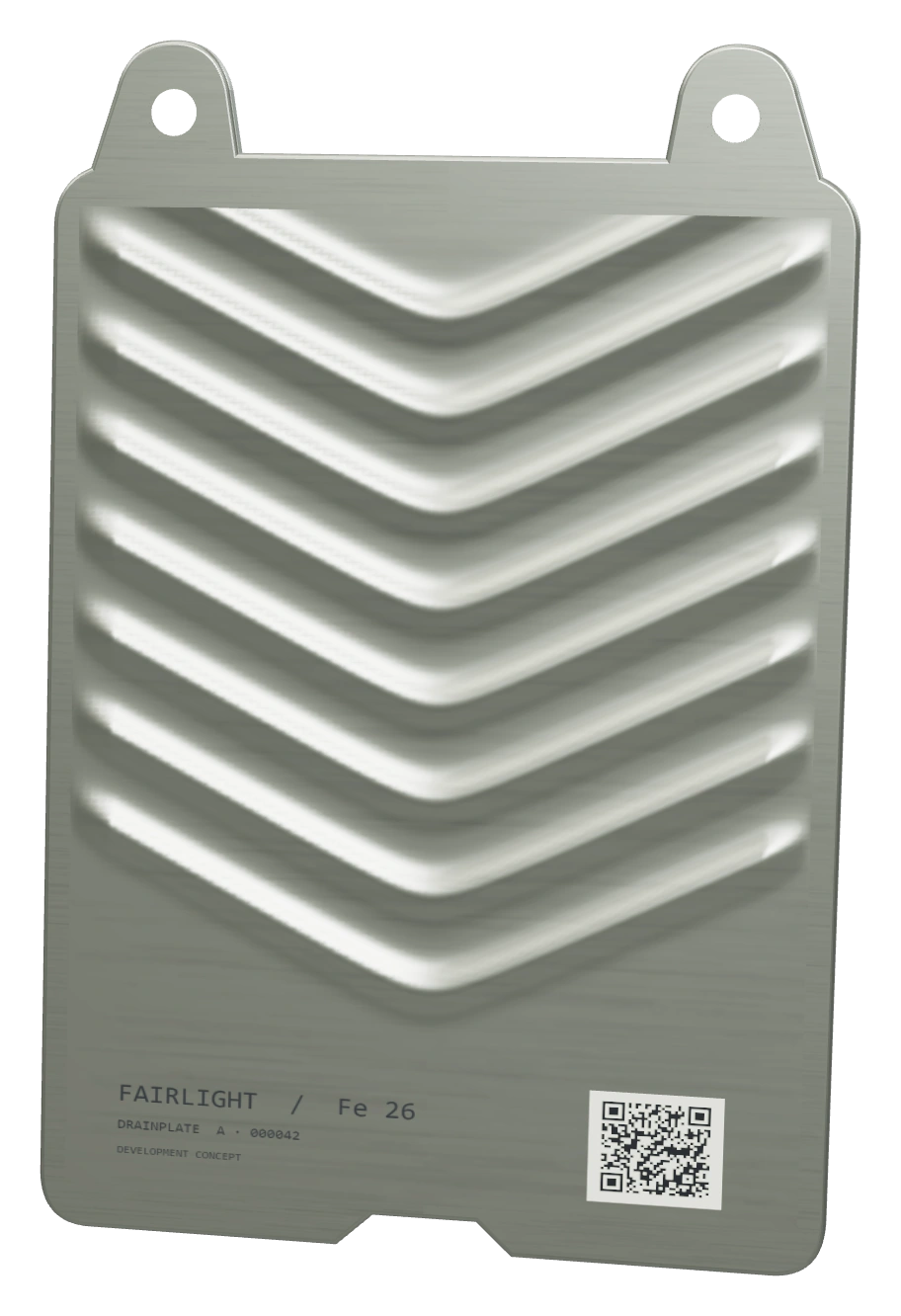
DrainPlate substrate / development geometry
Move the liquid.
Formed channels guide electrolyte across the electrode pack and its active surface.
Accessibility, not just mass ↗

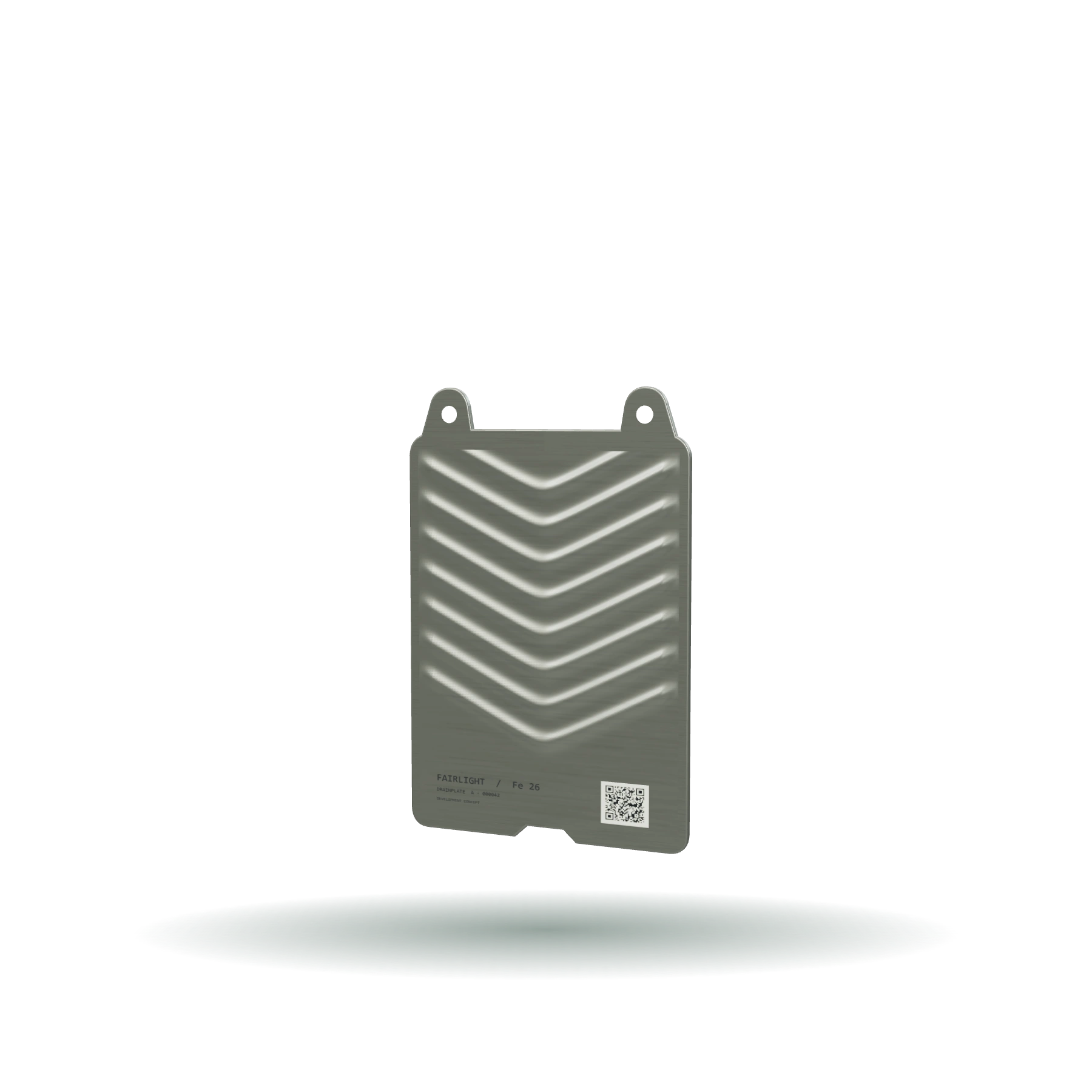
The electrode pack
A replaceable electrode pack sits inside a common mechanical carrier. The active iron architecture remains under validation.
Scroll to follow the carrierPreserve summer energy in reusable iron carriers for later use.
Fairlight’s seasonal operating window is a development objective.
Generation. Buffering. Inventory.
Solar supplies immediate demand. A lithium-ion battery manages fast response and the daily cycle. Fairlight is developing a third layer: standardized physical carriers designed to hold stored renewable electricity for weeks or months—and to move it.
Accessibility, not just mass
Iron is abundant. But useful electrochemical capacity depends on how much iron can actually participate reversibly. A smooth steel plate presents very little accessible surface; practical iron electrodes rely on high-area structures, engineered microstructure and surface treatment. Fairlight is studying high-area iron structures, microstructure, surface treatment and active-layer architectures compatible with the FEC carrier. The exact active electrode architecture remains under validation.
Current system benchmark
Published iron-air system evidence sits at roughly 40–45% round-trip efficiency. Improving the complete system—electrode, electrolyte, air electrode, process energy and auxiliaries—is the development objective. Fairlight system efficiency has not been measured yet.
Capacity scales with objects, not machines
Additional storage capacity comes from additional carriers, while a common station performs processing and preservation. Power and stored capacity are engineered as separate decisions, and the electrode inside a carrier can be revised without changing the envelope.
Explore the detail.
Version 0.1 documents are prepared for a future public release. Contact Fairlight for publication updates.
Research & Validation Plan
The experimental programme and reporting approach.
v0.1 · Awaiting public releaseAsk about this documentPublic Technical Whitepaper
The seasonal storage thesis and development architecture.
v0.1 · Awaiting public releaseAsk about this document